
Trace Butler County Former Owners Backward
Start with the newest transfer tied to the right parcel. Then move backward one conveyance at a time, never skipping a link. Butler County deed records are recorded by the Judge of Probate. The office publishes no official online starting year for its land-record index. So your source depends on the era you need. Older books may sit with the state archives while newer ones stay in Greenville.
| Source | Years It Covers | Where Held | What It Shows |
|---|---|---|---|
| Probate deed index | Online depth not published | Probate portal and office | Parties, dates, instrument leads, and cross-references |
| Original deed books | Book-dependent | Probate Office | Full conveyance text and legal descriptions |
| County microfilm | Record-type dependent | ADAH catalog and originating office | Older county series and catalog leads |
| Plats and local files | Item-dependent | Probate, library, municipal records | Lot identity, old place names, and subdivision context |
Use the portal for a first index check. Call or visit the Probate Office when the book you need does not appear. For a much older chain, search the Alabama Department of Archives and History county microfilm catalog, then confirm whether the original volume remains in Greenville.
Keep the Butler County Land Description Fixed
Names alone make a weak chain key. Two people can share a surname. An estate can replace an individual, and a company can appear under slightly different spellings across deed records. Match the parcel number at every step. Also match the deed book and page, plat reference, acreage, and full legal description. A street address helps with discovery. But older rural deeds lean on metes and bounds, a road or creek call, or section-township-range. Hold the land identity constant and let the owners rotate around it.
- Grantor
- The party conveying an interest.
- Grantee
- The party receiving the interest.
- Chain of title
- The ordered series of instruments affecting the same land.
- Reverse index
- An index used to find the instrument by the receiving party.
- Quitclaim and warranty deed
- Different conveyance forms; neither should be inferred from the index label alone.
Copy identifiers exactly as written. Butler's Revenue search uses parcel, PPIN, BPPIN, account, and receipt controls, while the Flagship interface displays a different parcel mask. Confirm a live parcel match before treating the two formats as interchangeable.
Open Butler Probate's Land-Record Route
The Butler Probate portal offers a "Look up Land Records" option. It also provides probate-case access and a record-account login. General INGRecords instructions describe party, date, book and page, instrument, sort, document-view, cart, and cross-reference controls. The Butler screen does not expose every one of those fields in static form. Check the live page before assuming a given search control is active for this county.
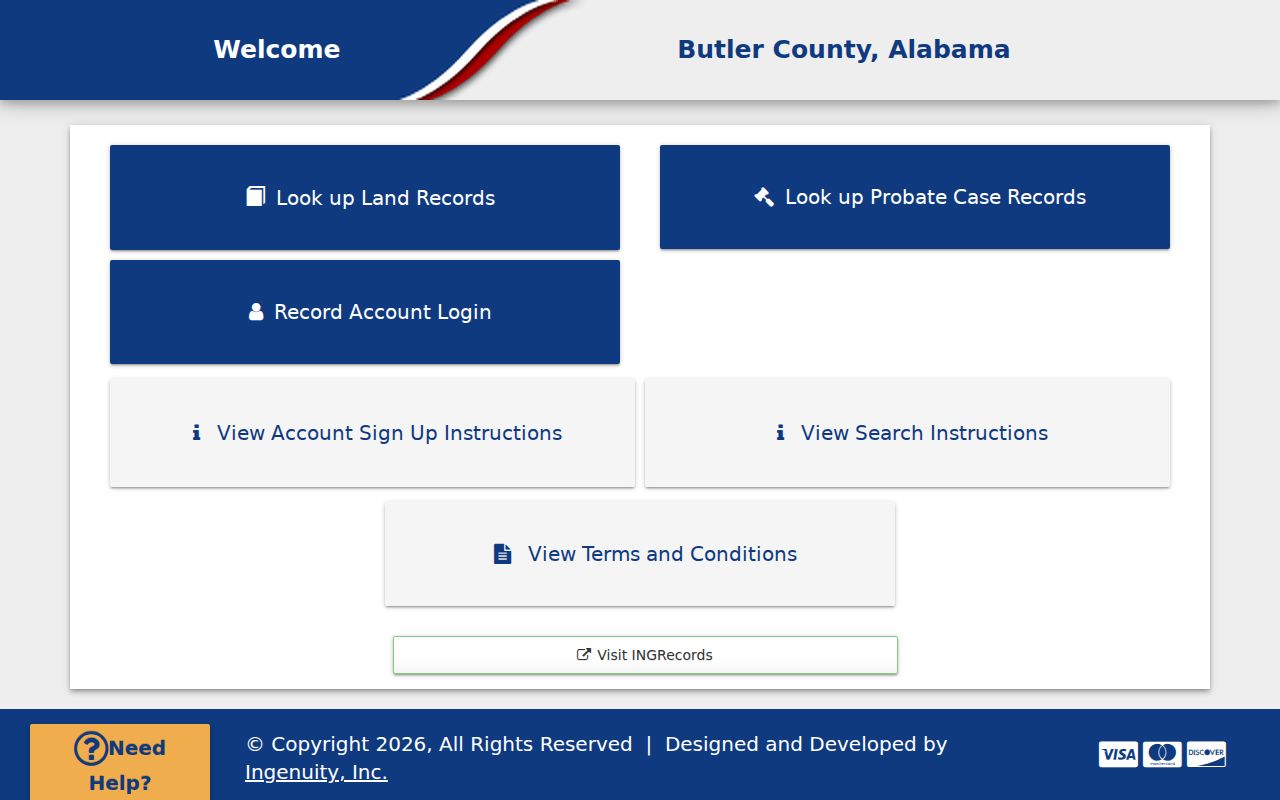
The landing page shows the land-record entry point. It does not reveal how deep the historical index runs or what a prior-transfer result contains, so plan on testing the search yourself.
| Control | Use in a prior-owner search | Known limit |
|---|---|---|
| Party and role | Search grantor, grantee, assignee, or all | Final Butler options were not exposed |
| Starts With | Broaden or narrow a name match | Spelling variants still need review |
| Date or book/page | Target a known transfer | Online coverage is unpublished |
| Instrument type | Separate likely conveyances from other filings | Local option list was not captured |
The portal may lead to purchasable deed images. Butler's exact image and certification fees are not posted, so ask the Probate Office before ordering. The related INGRecords county-selection service documents the public-search and document-purchase route.
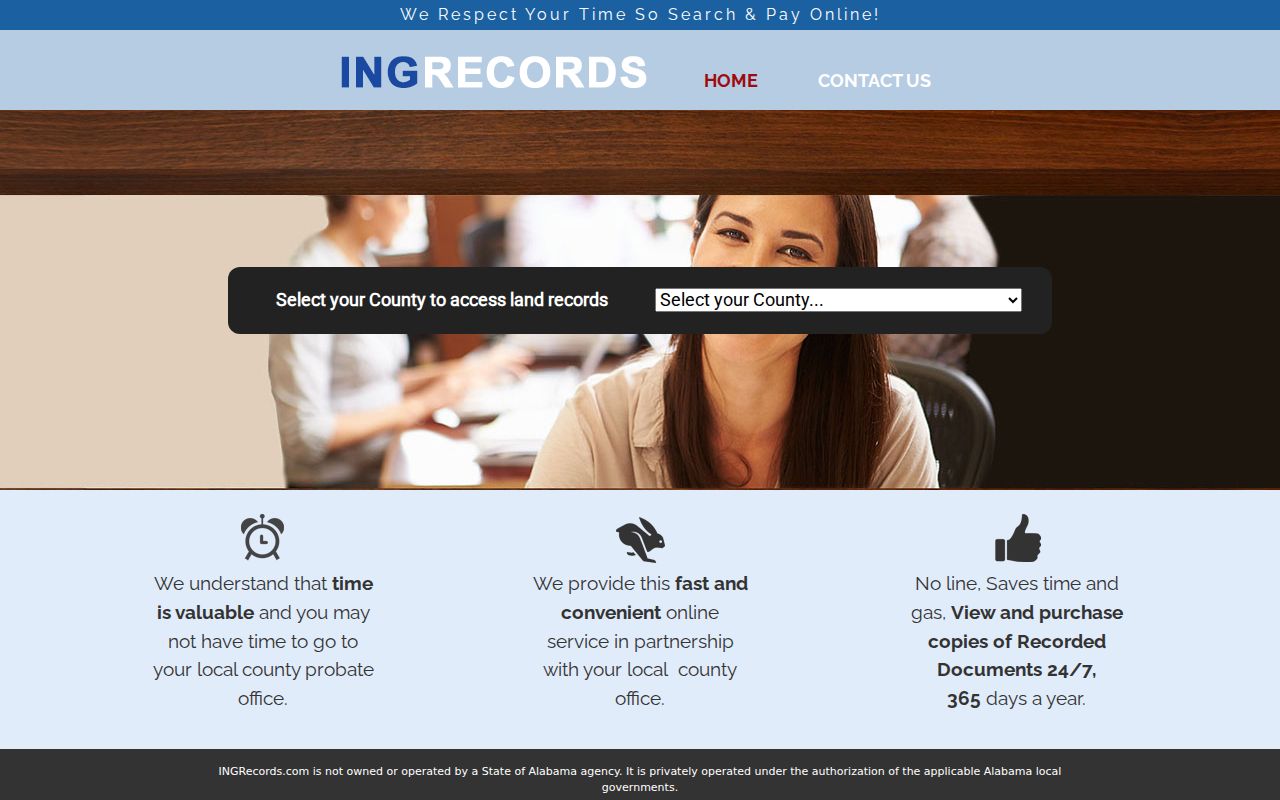
The vendor gateway behind Butler Probate's land-record route handles payment and document delivery. It does not replace an official Butler result that names the parties, the date, the instrument, and the legal description.
Walk Butler County's Deed Chain in Reverse
A backward chain starts with a verified recent deed, not just a name on an old tax screen. Each step is a research move. No row stands for an actual parcel transfer.
| Transfer date | Grantor to grantee | Deed type | Book/page or instrument |
|---|---|---|---|
| Newest verified filing | Prior owner to current grantee | Read from index and image | Copy exact reference |
| Earlier acquisition | Earlier owner to that prior owner | Confirm instrument | Match land description |
| Next earlier transfer | Repeat one link back | Note corrections or estate papers | Carry cross-references |
Build the timeline only after confirming the same land in every row. A correction deed, partial conveyance, split, or combined tract can make a name-only sequence look complete when it is not. Land descriptions, not surnames, hold the chain together.
- Find the newest deed with the current grantee and matching legal description.
- Record its grantor, filing date, deed type, book/page, and cross-references.
- Search that grantor as an earlier grantee and confirm the same tract.
- Repeat until the portal ends, then continue at the office or through the proper historic volume.
Note: An index entry only points to an instrument, so the recorded image and its legal description supply the evidence that joins the chain.
Recover Butler County Owners Through Estates
A clean buyer-to-seller chain can pause when land passed through an estate. Search the decedent, the estate name, the personal representative, the heirs, and the later buyer. Butler Probate handles estates, wills, guardianships, and conservatorships. Its landing page includes a probate-case route. The case file can explain who held authority to sell. A later executor's deed, heirship affidavit, or surviving-joint-tenant instrument then follows. It moves the property transfer into the land records.
Never assume a will alone changed the recorded chain. Compare the probate matter with any deed tied to the land. Also check any affidavit, court order, or corrective filing tied to it. The county Probate Office page gives the office route. It covers records that do not resolve online.
Use Butler Plats to Follow a Changing Lot
Subdivision language can preserve land identity long after street names and parcel numbers change. Record the subdivision, lot, block, plat book and page, and deed description. Then compare the original or amended plat with the present parcel. Greenville planning minutes offer one concrete example. The James Dunklin subdivision was recorded June 13, 2024. It appears in Butler Probate Plat Book 4, page 372.
That example is a method clue, not evidence about any other parcel. For rural former owners, follow section-township-range or metes-and-bounds calls through predecessor deeds. For city lots, an amendment, vacation, or replat can explain a change. An older deed may describe a shape that no longer matches the current tax polygon. The plat page, not the map alone, settles the question.
The 1853 Butler Courthouse Fire Changes the Search
ADAH's official courthouse-fire list identifies an 1853 Butler County fire. The notice names no lost volumes. No deed books or plat books are listed. No probate volumes or tax rolls appear either. It would be wrong to call the early record set wholly destroyed. It would be equally wrong to call it wholly intact without a volume inventory.
Ask by series. Give the Probate Office a book, date range, and record type, and ask whether the item is original, reconstructed, indexed, or available on microfilm.
ADAH's WPA materials add a useful historical bridge for Butler County. A finding aid identifies Butler Commissioners' Court transcripts spanning 1853 through 1907. Those public-administration records may supply context, but they cannot replace a missing conveyance or prove a former owner of record.
Broaden a Butler County House History at the Library
A clean deed chain gives you names. Names alone tell you little. The Greenville-Butler County Public Library's BCHGS research room fills in the people and places around a Butler County parcel, with clippings, obituaries, cemetery material, family papers, census and military sources, and county-history files. Volunteers staff the room on Tuesdays. The collection also opens during regular library hours.
Expect spelling variants, old community names, church and school references, and family ties that explain an odd index result. Treat every clue as supporting evidence. Return it to a recorded deed, plat, estate file, or other official record before it enters the ownership timeline.
Reach Butler Former-Owner Records Offline
When the web route stops, contact the Butler Probate Office at 700 Court Square, Greenville, Alabama 36037, or call 334-382-3512. Posted hours are Monday, Tuesday, Thursday, and Friday from 8:00 a.m. to 4:00 p.m., and Wednesday from 8:00 a.m. to noon. Ask whether the index, image, deed book, plat, or certification you need is available at the counter or by request, and get a fee estimate first.
For a documented public writing the office route does not supply, Alabama Code §36-12-40 grants citizen inspection and copying rights, subject to exceptions and reasonable procedures. Describe an existing record precisely. ADAH serves as the microfilm and catalog fallback, while the library is the local-history fallback. Call either one the original custodian only if its catalog says it holds the item.
Know Where Butler County Ownership Coverage Ends
Butler County publishes no official start year for its online deed records. No cutoff year exists. An Alabama land-title association survey listed Butler among counties with no online land records. The county-linked portal now shows a land-record entry anyway. The mismatch may reflect a later change or a narrow vendor workflow. That still justifies no start year.
An empty search result is not a gap. Test name variants, roles, dates, book and page numbers, plats, and legal descriptions. Draw no conclusion before that. Then ask the Probate Office which older index or deed-book series continues the chain. Ask also about the fire's effect on the earliest records. Ask about any reconstructed index or ADAH microfilm.
Coverage warning. Butler County's online deed-index start year is not published. Older owners may require the Probate counter, deed books, or record-specific microfilm.
Former-owner research has real uses. It supports house history, estate work, and property diligence, and formal title conclusions belong with a qualified Alabama title professional. Public records never license harm, so never use property information to stalk, harass, threaten, or harm anyone.